
WESTERN AUSTRALIA
Hutt Lagoon, Yallabatharra, Western Australia
Hutt Lagoon is just east of Port Gregory. George Grey Drive (the road to Kalbarri) traverses its eastern shore.
The lagoon is 16 kilometres in length and averages about 1.5 kilometres in width.
-
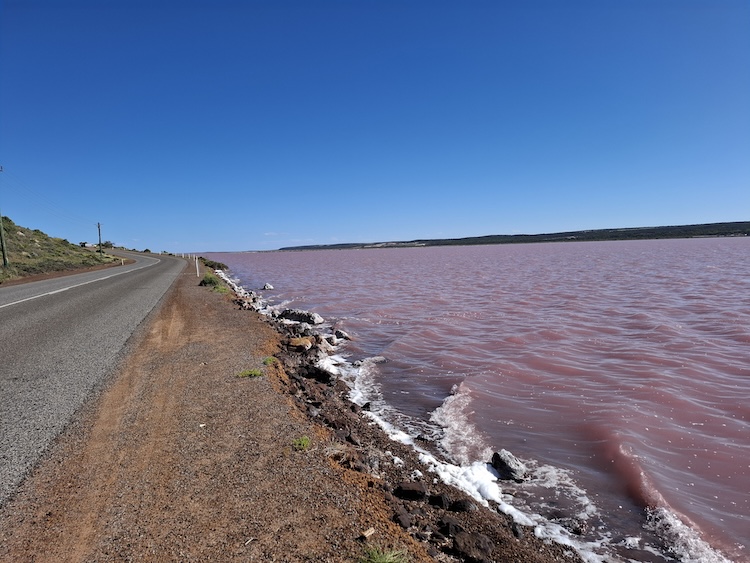
- Port Gregory Road runs alongside the western side of Pink Lake. George Grey Road traverses the eastern shore of the lake.
Given its persistency of pinkness and its easy accessibility (a sealed road on the way to Kalbarri with a convenient lookout/parking area) Hutt Lagoon is clearly the ‘best value pink lake’ in Australia.
Hutt Lagoon is more consistently pink than the other ‘pink lakes’ of Australia.
Lake Hillier, Middle Island, Recherché Archipelago, Western Australia
Those with a vested interest in Lake Hillier’s ‘pinkness’ claim that it is a permanently-pink lake, however, that is not the case. The lake is on Middle Island in the Recherché Archipelago, nine kilometres south of Cape Arid, east of Esperance.
-

- Lake Hillier, Cape Arid. Courtesy lakehillier.com
When pink Lake Hillier is spectacular. It is best accessed by a scenic flight (60 minutes/$350-2025 prices). Tourist boat trips to Middle Island are also available.(or any island in the Archipelago other than Woody Island).
The best time to see the lake is in the period May to December.
Permits to land on the island are required from the Department of Biodiversity, Conservation and Attractions.
Lake Warden, Esperance, Western Australia
This lake is adjacent to Lake Spencer (Pink Lake). The last known instance of any pinkness in the lake was in 2020. It lies between the South Coast Highway and the Coolgardie-Esperance Highway and is best viewed from the latter.
Lake Warden is about five kilometres north of Esperance in the Esperance Lakes Nature Reserve.
Collectively Lakes Warden, Spencer (Pink Lake), Wheatfield, Woody, Windabout, Mullet, Station, Ewans and up to 90 smaller lakes are part of the Lake Warden Wetlands System. They are often seen, somewhat deceptively, as being pink in some photographs.
Pink Lake Esperance (Lake Spencer), Western Australia
Lake Hillier is is often confused with the not-pink Pink Lake in Esperance (Lake Spencer) – which is a great disappointment to the many tourists who flock to its shores only to read a bland, unspectacular signboard that explains why the lake is no longer pink. One could be excused for believing that this misunderstanding is allowed to prevail.
Pink and Blue Lake, Quairading, Western Australia
This small lake is on the York-Merredin Road, 11 kilometres north-north-east of Quairading. The road divides the lake with one portion sometimes being pink and the other side not-so-pink. Sometimes blue/black.
Pink Lake, Rottnest Island, Western Australia
The little known and unofficially titled ‘Pink Lake’ on Rottnest Island is on the Gabbi Karniny Bidi hiking trail, between Baghdad Lake and the Lighthouse.
The colour of the lake is best at sunrise/sunset when salinity and light enhance the pink tint. The Pink Lake’s colour also varies with season. It is most reliable outside the dry summer period.
Pink Lakes, Southern Ocean Road, Jerdacuttup, Western Australia
There are pink lakes on Southern Ocean Road – virtually unknown except to the cognoscenti.
-

- One of the Jerdacuttup Lakes.
Southern Ocean Road is unsealed but quite suitable for 2WD vehicles when dry. It runs 50 kilometres from just east of Hopetoun to Springdale Road in Jerdacuttup.
-

- An un-named pink lake on Southern Ocean Road, Jerdacuttup, one of a number of similar bodies of water that make up the Jerdacuttup Lakes.
SOUTH AUSTRALIA
Lake Albert, Coorong, South Australia
Lake Bumbunga, Lochiel, South Australia
A picturesque pink lake at Lochiel about 1.5 hours from Adelaide is known for its changing shades of pink.
Lake Eyre, South Australia
Australia’s largest salt lake occasionally show the colour of pink when flooded.
Lake Hart, South Australia
Pink Lake, Kangaroo Island, South Australia
Pink Lake, Yorketown, South Australia
Lake McDonnell, Penong, South Australia
Lake McDonnell is 13 kilometres south of Penong in South Australia – a short diversion from the iconic Eyre Highway drive. Though spectacular when conditions are right, it is not always pink. Its colour is dependent on numerous environmental factors.
VICTORIA
Lake Becking, Victoria
One of the Murray Sunset National Park Pink Lakes.
Lake Crosbie, Victoria
One of the Murray Sunset National Park Pink Lakes.
Lake Hardey, Victoria
One of the Murray Sunset National Park Pink Lakes.
Lake Kenyon, Victoria
One of the Murray Sunset National Park Pink Lakes.
Lake Tyrrell, Victoria
The largest salt lake in Victoria, it is located six kilometres north of the town of Sea Lake and 314 kilometres north-west of Melbourne.
Murray Sunset National Park Pink Lakes, Victoria
A collection of lakes (Lake Crosbie, Lake Becking, Lake Kenyon, Lake Hardy) on Pink Lakes Road in the Murray-Sunset National Park, Victoria 300 kilometres east of Adelaide.
Nerrin Nerrin Lake, Victoria
Sometimes unkindly referred to as Nerrin Nerrin Swamp.
Pink Lake, Dimboola, Victoria
Victoria’s Dimboola Pink Lake is six kilometres north-west of Dimboola along the Western Highway. As with most ‘pink lakes’ the colour derives from a salt tolerant alga living in the crust of salt that covers the lake. The colour varies throughout the seasons and is generally most vivid after rain events. Extended dry periods cause the pink to fade completely to white. It may then return to pink following the next rain event.
Westgate Park Lake, Melbourne, Victoria
Westgate Park Lake is a man-made lake located in Port Melbourne beneath the Westgate Bridge. It is renowned for its seasonal transformation into a vibrant pink hue during summer months.This phenomenon occurs due to high salinity levels, elevated temperatures, increased sunlight, and reduced rainfall, which stimulate the growth of pink-pigmented algae (such as Dunaliella salina) and halobacteria that produce carotenoids for protection. The lake typically turns pink from December to February, with the peak viewing period often extending into March, though the color is not guaranteed and depends heavily on weather conditions.
Rest of the World
Pink lakes can be found in Azerbaijan, Bolivia, Canada, France, India, Iran, Kazakstan, Mexico, Namibia, New Zealand, Puerto Rica, Romania, Russia, Senegal, Serbia, South Africa, Spain, Tanzania, Turkey, Ukraine, United States, and Venezuela.
The Science Behind Pink Lakes
Each pink lake has its own unique characteristics, often influenced by factors such as algae, bacteria, rainfall, salt levels, and sunshine/time of day.
© Kim Epton 2025
1068 words, four photographs.
Feel free to use any part of this document but please do the right thing and give attribution to adventures.net.au. It will enhance the SEO of your website/blog and Adventures.
See Terms of Use.