
Building of Beringbooding Rock Tank and Water Harvesting System
Beringbooding Rock has the largest rock water catchment in Australia. Built in 1937 by ‘sustenance labour’, this tank holds more than 10,200,000 litres of water and cost £10,000 (about $1,500,000 in 2026).
In February 1936 the Mukinbudin Roads Board took up the cause for a rock catchment in Beringbooding. The Agricultural Bank figures stated that in 1935 it had 154 clients in Wialki and Bonnie Rock and of those 104 were totally dependent on Government water supplies which had failed in 1935/36 and again in 1936/37.
In August 1937 with settlers losing heart as they faced another dry year approval for £10,000 was given to build a tank on Beringbooding Reserve 3038 due to it being centrally located with a good catchment.
-
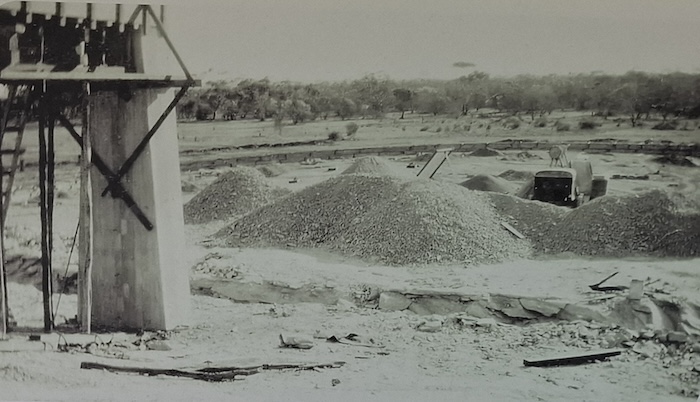
- Material stockpile for Beringbooding Tank.
Unfortunately, the Beringbooding Tank came too late for most of the settlers. By 1941 the Bonnie Rock and Yanoning districts were nearly depleted and by 1942 local farmer Monty Masefield was the only settler east of Yanoning Rock – the only farmer within 15 kilometres of the ten million litre tank.
Today there are quite a few more farmers in the area and the tank is still being used for crop spraying and drinking water for stock. It is no longer treated adequately for human consumption. Although the roof has been removed for safety reasons after it deteriorated, the foundations remain as sturdy as ever.
-
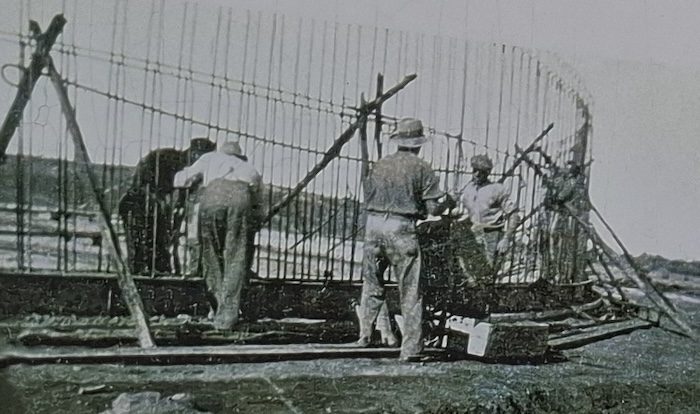
- Preparing the steel reinforcing for the tank.
Beringbooding Rock Dam, harvesting walls and water channels were built over a two year period by one hundred men. All the workers came from Perth and their duration of employment depended on how many children each of them had. These men were unemployed during the Depression and were on what was known at the time as “sustenance labour”. They were transported to Bonnie Rock on Friday’s train.
-
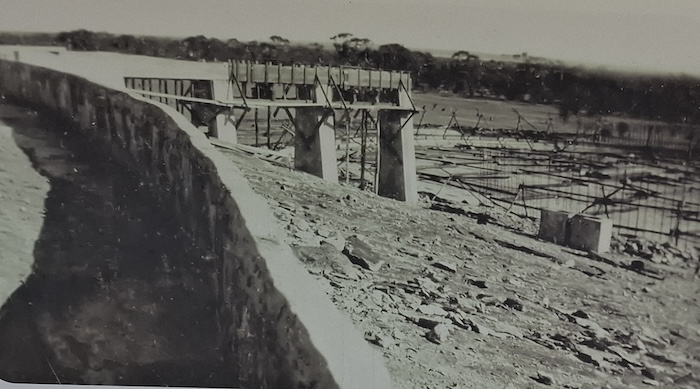
- The channel to divert water into the yet-to-be-built tank has already been constructed.
Mr Phil Avery was the engineer and Mr Jimmy Bullen the foreman. There was a definite class distinction as the truck driver, the foreman, the paymaster and the engineer all lived in the Engineer’s house which was built on the northern side of the rock. The Engineer’s house was built near what was termed the kangaroo hole enabling it to be plumbed into this and have running water! All the other workers camped in rows of tents on the other side of the rock. The workers had cooking fires in front of their tents and did not mix socially with the residents of the Engineer’s house.
-
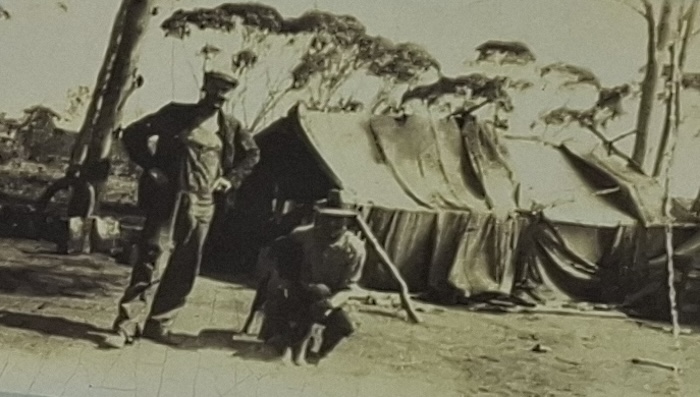
- The workers were accommodated in tents.
All the wood and the cement came in on Friday’s train to Bonnie Rock. The metal (crushed rock or aggregate) for the concrete was crushed on site using local material. Work was nearly all manual with shovels and steel wheelbarrows being used to work the concrete. No front end loaders and no powered cement mixers.
Return to Granite Outcrops of the Wheatbelt.
© This format Kim Epton 2026
493 words. Not written by AI.
Four photographs.
You are welcome to use any part of this document. Please attribute adventures.net.au — it will help your site’s SEO as well as that of adventures.net.au
See Terms of Use.